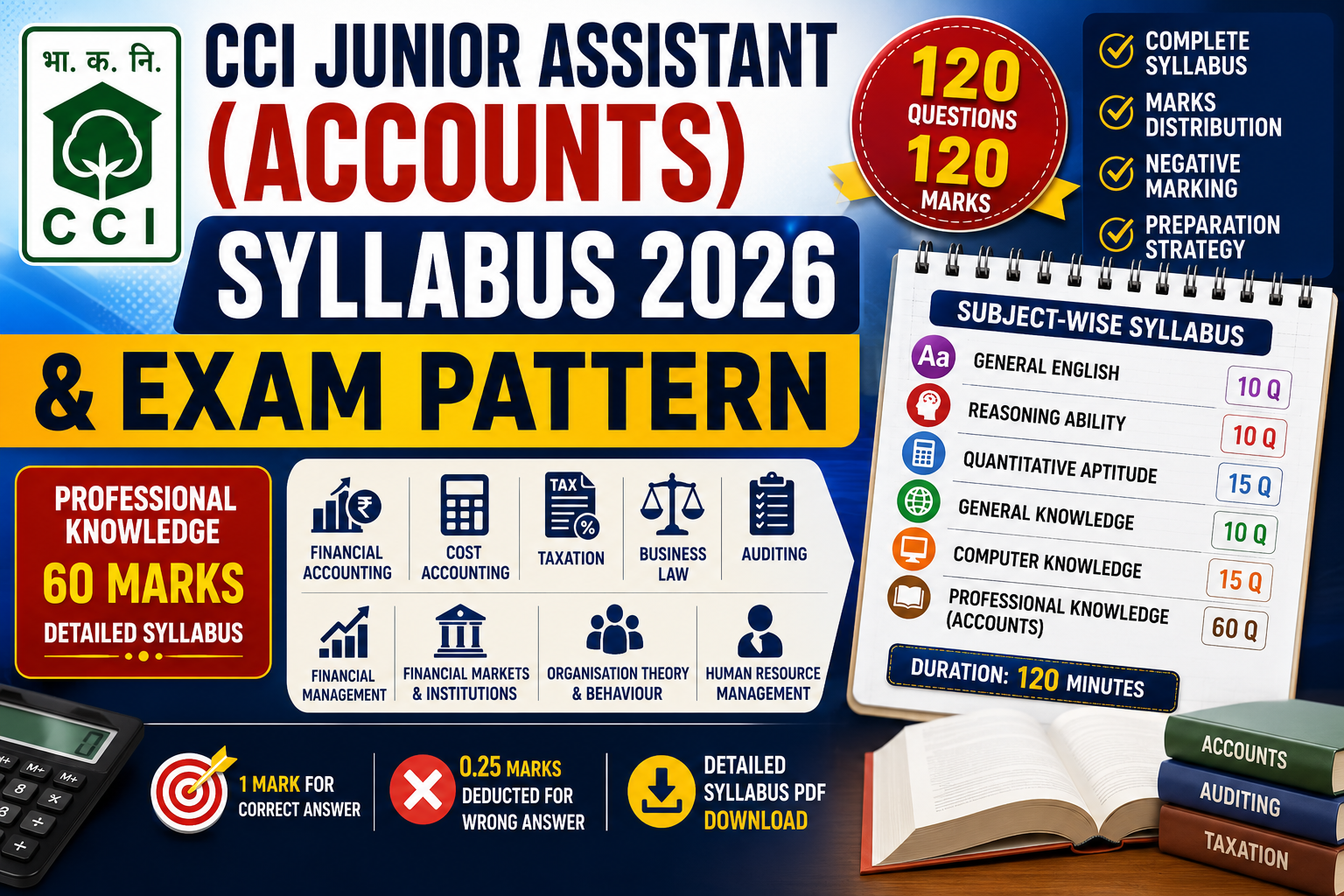
If you are preparing for the CCI Junior Assistant (Accounts) Recruitment 2026, understanding the latest official exam pattern and syllabus is the first step towards success. The examination consists of 120 objective-type questions carrying 120 marks and includes both aptitude and professional knowledge sections.
In this article, we have explained the complete CCI Junior Assistant (Accounts) Syllabus 2026 in detail along with the latest exam pattern, marking scheme, subject-wise topics, and preparation strategy.
The syllabus and exam pattern discussed below are based on the official CCI notification.
CCI Junior Assistant (Accounts) Exam Pattern 2026
The Computer Based Test (CBT) consists of 120 Multiple Choice Questions (MCQs).
|
Subject |
Questions |
Marks |
|
General English |
10 |
10 |
|
Reasoning Ability |
10 |
10 |
|
Quantitative Aptitude |
15 |
15 |
|
General Knowledge |
10 |
10 |
|
Computer Knowledge |
15 |
15 |
|
Professional Knowledge (Accounts) |
60 |
60 |
|
Total |
120 |
120 |
Exam Highlights
-
Mode of Exam: Computer Based Test (CBT)
-
Total Questions: 120
-
Total Marks: 120
-
Duration: 120 Minutes
-
Question Type: Objective MCQ
-
Marks for Correct Answer: +1
-
Negative Marking: 0.25 Marks for each wrong answer
Section-I: General English Syllabus (10 Marks)
This section evaluates candidates' understanding of English grammar, vocabulary, and comprehension.
Topics Covered
-
Articles
-
Prepositions
-
Vocabulary
-
Synonyms
-
Antonyms
-
Reading Comprehension
-
Sentence Rearrangement
-
Jumbled Sentences
-
Fill in the Blanks
-
Error Detection
-
One Word Substitution
-
Idioms & Phrases
-
Active & Passive Voice
-
Direct & Indirect Speech
Section-II: Reasoning Ability Syllabus (10 Marks)
The reasoning section tests analytical and logical thinking.
Topics Covered
-
Syllogism
-
Coding-Decoding
-
Coded Inequalities
-
Blood Relations
-
Direction & Distance
-
Ordering & Ranking
-
Data Interpretation
-
Data Sufficiency
-
Deductive Logic
-
Number & Alphabet Series
-
Pattern Completion
-
Puzzle
-
Seating Arrangement
-
Analogy
-
Classification
Section-III: Quantitative Aptitude Syllabus (15 Marks)
This section measures numerical ability and mathematical aptitude.
Topics Covered
-
Ratio & Proportion
-
Percentage
-
Average
-
Profit & Loss
-
Discount
-
Time & Work
-
Time, Speed & Distance
-
Probability
-
Simple Interest
-
Compound Interest
-
Partnership
-
Number System
-
Simplification
-
Data Interpretation
Section-IV: General Knowledge Syllabus (10 Marks)
Questions are asked from current affairs and static general knowledge.
Topics Covered
-
Indian Geography
-
World Geography
-
Indian Economy
-
Indian Trade
-
Current Affairs (India & World)
-
Scientific Research
-
Awards & Honours
-
Sports
-
Important National & International Events
-
Government Schemes
Section-V: Computer Knowledge Syllabus (15 Marks)
Candidates should have a basic understanding of computers and MS Office applications.
Topics Covered
Computer Fundamentals
-
Computer Components
-
Input & Output Devices
-
Hardware & Software
-
Operating System
-
Memory Devices
-
Computer Networks
-
Internet & Communication
MS Word
-
Document Creation
-
Formatting
-
Tables
-
Styles
-
Mail Merge
MS Excel
-
Spreadsheet Creation
-
Cell Formatting
-
Formulas
-
Functions
-
Charts
-
Data Analysis
MS PowerPoint
-
Presentation Creation
-
Slide Layout
-
Themes
-
Animations
-
Multimedia
Other Topics
-
Computer Peripheral Devices
-
Keyboard Shortcuts
-
Computer Abbreviations
-
Internet Basics
Section-VI: Professional Knowledge (Accounts) – 60 Marks
This is the most important section of the examination, carrying 50% of the total marks.
1. Financial Accounting
Topics include:
-
Accounting as Information System
-
Accounting Standards (AS)
-
Depreciation
-
Inventory Valuation
-
Revenue Recognition
-
Fixed Assets
-
Government Grants
-
Cash Flow Statement
-
Earnings Per Share (EPS)
-
Share Capital Transactions
-
Bonus Shares
-
Rights Issue
-
ESOP
-
Buy-back of Securities
-
Company Final Accounts
-
Amalgamation
-
Absorption
-
Reconstruction of Companies
2. Cost Accounting
Important Topics
-
Nature & Objectives
-
Cost Concepts
-
Cost Accounting System
-
Job Costing
-
Process Costing
-
Activity Based Costing (ABC)
-
Cost-Volume-Profit Analysis
-
Differential Costing
-
Make or Buy Decisions
-
Shutdown Decisions
-
Budgeting
-
Standard Costing
-
Variance Analysis
-
Responsibility Accounting
-
Cost Control & Cost Reduction
3. Taxation
Topics Covered
-
Basic Concepts
-
Income Tax
-
Heads of Income
-
Salary
-
House Property
-
Business Income
-
Capital Gains
-
Other Sources
-
Clubbing of Income
-
Set-off & Carry Forward of Losses
-
Deductions under Income Tax
-
VAT
-
Service Tax (Basic Provisions)
4. Business Law
Important Acts
-
Indian Contract Act, 1872
-
Negotiable Instruments Act, 1881
-
Payment of Bonus Act, 1965
-
Employees' Provident Fund Act, 1952
-
Payment of Gratuity Act, 1972
5. Auditing
Topics
-
Company Audit
-
Dividend Audit
-
Tax Audit
-
Banking Audit
-
Insurance Audit
-
Audit of Trusts
-
Audit of Non-Profit Organizations
-
Special Investigation
6. Financial Management
Important Topics
-
Financial Management Objectives
-
Risk & Return
-
Ratio Analysis
-
Funds Flow Statement
-
Cash Flow Statement
-
Capital Budgeting
-
Cost of Capital
-
CAPM
-
Capital Structure
-
EBIT-EPS Analysis
-
Dividend Decisions
-
Walter Model
-
Gordon Model
-
MM Theory
-
Working Capital Management
-
Mergers & Acquisitions
7. Financial Markets & Institutions
Topics
-
Indian Financial System
-
Money Market
-
Commercial Banks
-
RBI
-
Monetary Policy
-
Capital Market
-
SEBI
-
Mutual Funds
-
Venture Capital
-
Credit Rating Agencies
-
Insurance
-
IRDAI
8. Organisation Theory & Behaviour
Topics
-
Organization Structure
-
Organization Design
-
Organizational Culture
-
Management by Objectives (MBO)
-
Centralization & Decentralization
-
Power & Politics
-
Leadership
-
Motivation
-
Organizational Change
-
Quality Circle
-
Conflict Management
-
Transactional Analysis
9. Human Resource Management (HRM)
Topics
-
Human Resource Planning
-
Job Analysis
-
Recruitment
-
Selection
-
Orientation
-
Training & Development
-
Performance Appraisal
-
360° Feedback
-
Wage & Salary Administration
-
Job Evaluation
-
Employee Welfare
-
Promotion
-
Transfer
-
Separation
Preparation Strategy
-
Focus primarily on Professional Knowledge, as it carries 60 marks, accounting for half of the total paper.
-
Strengthen fundamentals in Financial Accounting, Cost Accounting, Taxation, and Financial Management.
-
Practice aptitude and reasoning daily to improve speed and accuracy.
-
Revise current affairs and basic computer concepts regularly.
-
Attempt full-length mock tests to become familiar with the 120-minute exam duration and negative marking.
Final Words
The CCI Junior Assistant (Accounts) Syllabus 2026 is comprehensive and tests candidates on accounting fundamentals, finance, taxation, business law, auditing, financial management, computer knowledge, and aptitude. Since Professional Knowledge contributes 60 out of 120 marks, candidates should devote the majority of their preparation time to accounting and finance subjects while maintaining regular practice in English, Reasoning, Quantitative Aptitude, General Knowledge, and Computer Awareness.
Candidates who prepare according to the official syllabus and consistently practice mock tests will significantly improve their chances of success in the CCI Junior Assistant (Accounts) Recruitment 2026 examination.
|
Follow Me |
|
|
YOUTUBE |
|
|
Telegram Discussion Group |
|
|
Telegram Vacancy update Group |
|
|
|
|
|
WhatsApp Discussion Group |
|
|
WhatsApp Vacancy update Group |
|
|
WhatsApp Channel |
|
|
|
|
|
Important Links |
|
|
To Download Notification 2026 PDF |
|
|
Syllabus PDF |
|